

CRM integration for eCommerce is no longer optional. It is a must-have for any online store that wants to grow. When your CRM and eCommerce platform talk to each other, your team gets a clear picture of every customer. You can act faster, personalise better, and sell smarter.
At Hilton Software Technologies, we help businesses connect their systems and unlock the full power of their customer data. In this guide, we walk you through everything you need to know — from the basics to the best tools and common mistakes to avoid.
Why CRM Integration for eCommerce Matters
Running an online store generates a huge amount of customer data. Every order, abandoned cart, and support request tells an important story. But when this information is scattered across different platforms, your teams miss valuable insights and opportunities.
Without CRM Integration
- Your sales team doesn’t know what a customer purchased last week.
- Your marketing team sends irrelevant or duplicate campaigns.
- Your support team spends valuable time searching for order history.
- You lose repeat customers because follow-ups happen too late.
With CRM integration for eCommerce, everything changes. Customer information is centralized into one connected system, allowing sales, marketing, and support teams to access the same real-time customer history. This leads to faster decisions, personalized experiences, and stronger customer relationships.
📈 Key Stat:
Businesses that integrate CRM with eCommerce report up to a 29% increase in sales and a 34% improvement in customer retention.
Source: Salesforce
What Is CRM Integration for eCommerce?
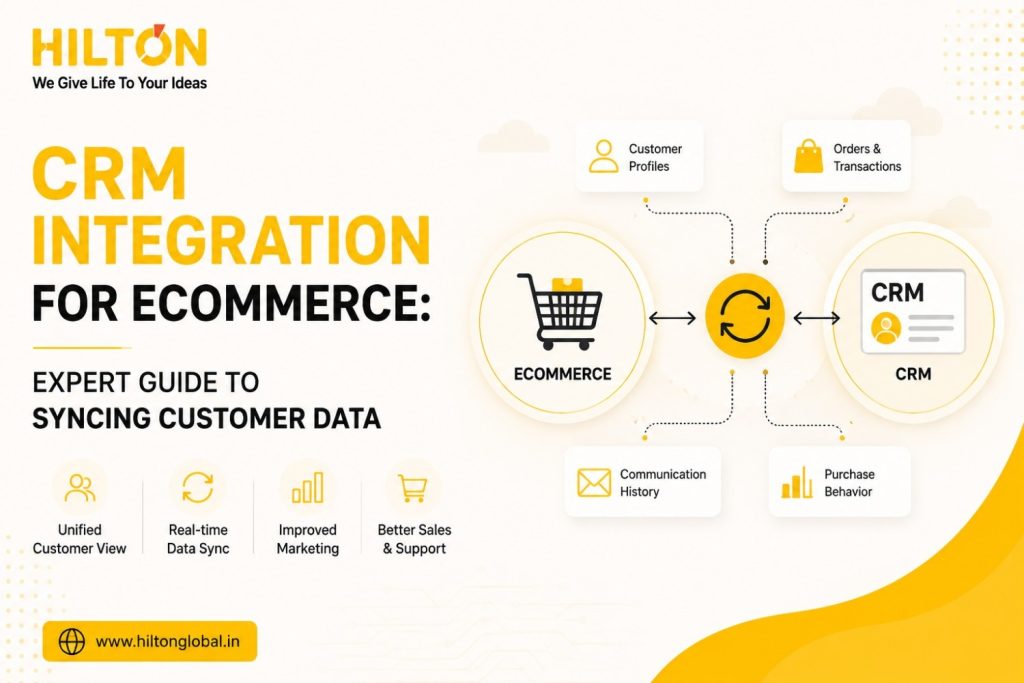
CRM integration for eCommerce is the process of connecting your Customer Relationship Management (CRM) platform with your online store so that customer information automatically syncs between both systems in real time.
How It Works
Whenever a customer places an order, updates their profile, or contacts support, the information is instantly synchronized with your CRM. This gives every department access to accurate customer records, complete purchase history, support interactions, and marketing engagement—all from a single source of truth.
Instead of working with disconnected tools, your business benefits from a unified customer view, enabling smarter marketing, faster customer support, improved sales follow-ups, and better business decisions.
What Data Gets Synced in CRM Integration for eCommerce?
A successful CRM integration automatically synchronizes customer and business data between your online store and CRM platform, ensuring every team works with accurate, real-time information.
| DATA TYPE | FROM ECOMMERCE STORE | SYNCED TO CRM |
|---|---|---|
| Customer Profile | Name, email, address | Unified customer record |
| Purchase History | Orders, products, order value | Buying behaviour & customer lifetime value |
| Cart Behaviour | Abandoned carts | Recovery & remarketing triggers |
| Support Tickets | Queries & complaints | Complete customer service history |
| Marketing Activity | Email opens, clicks, campaigns | Campaign performance & engagement insights |
💡 Why this matters: When all customer information is synchronized automatically, your sales, marketing, and support teams always work from the same accurate customer profile.
How CRM Integration for eCommerce Works
A typical CRM integration follows a simple but powerful workflow that keeps your customer information synchronized automatically.
Your online store captures customer actions such as purchases, registrations, page visits, and abandoned carts.
APIs or middleware securely transfer customer information from your eCommerce platform to the CRM.
Customer profiles, purchase history, tags, and segments are automatically updated in real time.
The CRM triggers personalized emails, follow-ups, notifications, or sales workflows based on customer behaviour.
Interactive dashboards and reports provide a complete 360° view of every customer and overall business performance.
🚀 Result: Instead of managing disconnected systems, your business operates from one centralized customer database—improving collaboration, automation, customer experience, and decision-making.
Integration Methods: Which One Is Right for You?
There are several ways to connect your CRM with an eCommerce platform. The right choice depends on your business size, technical requirements, and future scalability.
| METHOD | BEST FOR | COMPLEXITY |
|---|---|---|
| Native Integration | Popular platforms like Shopify + HubSpot | Low |
| API-Based Integration | Custom workflows and maximum flexibility | Medium–High |
| Middleware / iPaaS | Multi-platform ecosystems (Zapier, Make) | Medium |
💡 Expert Tip: Our eCommerce Development Services team helps you evaluate your existing technology stack and recommends the most scalable CRM integration approach for your business.
Top CRM Platforms for eCommerce Integration
Not every CRM is designed for eCommerce. Some platforms provide stronger integrations, automation capabilities, and customer management features than others. Here’s one of the most popular choices.
🏆 1. HubSpot CRM
- Free plan available with excellent eCommerce integration capabilities.
- Native connectors for Shopify, WooCommerce, and Magento.
- Powerful marketing automation, lead nurturing, and sales pipeline management.
- Best For: Small to mid-sized eCommerce businesses looking for an all-in-one CRM solution.
2. Salesforce Commerce Cloud
- Enterprise-grade CRM with deep eCommerce capabilities.
- AI-powered personalization using Salesforce Einstein.
- Highly customizable with extensive API support.
- Best For: Large-scale enterprise eCommerce businesses.
3. Zoho CRM
- Affordable yet packed with business automation features.
- Powerful workflow automation and lead management.
- Reliable integrations with Shopify and WooCommerce.
- Best For: Growing businesses looking for a cost-effective CRM.
4. Klaviyo (eCommerce-First CRM)
- Purpose-built for eCommerce email and SMS marketing.
- Advanced customer segmentation based on purchase behaviour.
- Seamless integration with Shopify and BigCommerce.
- Best For: Brands focused on customer retention and lifecycle marketing.
💡 Hilton Software Technologies Tip: Choose your CRM based on your existing eCommerce platform, business size, future scalability, and automation requirements. The lowest-cost solution isn’t always the one that delivers the best long-term value.
Key Benefits of CRM Integration for eCommerce
1. A Unified Customer View
CRM integration brings every customer interaction into one centralized dashboard. From the first website visit to the latest purchase and support request, your team has complete visibility, enabling faster responses and more personalized customer experiences.
2. Smarter Marketing Campaigns
With synchronized CRM data, you can build highly targeted campaigns based on real customer behaviour, including:
- Purchase history
- Average order value
- Preferred product categories
- Last purchase date
📈 Result: Higher email open rates, better click-through rates, and improved marketing ROI.
3. Better Customer Retention
CRM integration helps identify customers who are at risk of leaving before they actually do. Automated win-back campaigns, personalized offers, and loyalty programs become much more effective because they’re based on real customer behaviour instead of guesswork.
💡 Business Impact: A connected CRM doesn’t just organize customer data—it helps increase customer lifetime value, improve retention, and create more personalized shopping experiences that drive long-term business growth.
4. Faster Customer Support
With complete customer profiles and order history available inside your CRM, support agents can resolve issues much faster. Customers don’t need to repeat information, resulting in quicker resolutions, higher satisfaction, and a better overall support experience.
5. Accurate Sales Forecasting
Real-time sales and customer data automatically flow into your CRM, making reports more accurate and forecasting more reliable. This helps businesses manage inventory efficiently, identify sales trends, and make smarter business decisions.
eCommerce Development Services That Power CRM Integration
The success of your CRM integration depends on the quality of your eCommerce platform. Poorly designed stores often suffer from inconsistent customer data, broken APIs, and unreliable synchronization.
At Hilton Software Technologies, our eCommerce Development Services are designed with CRM integration in mind from day one. We build scalable, secure, and integration-ready solutions that grow with your business.
- ✓ Clean data structures that map seamlessly to CRM fields.
- ✓ Scalable APIs that enable reliable real-time synchronization.
- ✓ Custom middleware for complex multi-platform ecosystems.
- ✓ Automated testing to maintain data accuracy after every deployment.
- ✓ Secure OAuth and token-based authentication for safe CRM connectivity.
✔ Integration Ready: Whether you’re using Shopify, WooCommerce, Magento, or a custom-built platform, our solutions ensure your CRM integration remains secure, reliable, and ready to scale as your business grows.
Common Mistakes in CRM Integration for eCommerce
Even experienced development teams can run into integration issues. Avoiding these common mistakes helps ensure a smooth, scalable, and reliable CRM implementation.
⚠ Mistake 1: Syncing Too Much Data
More data isn’t always better. Syncing unnecessary fields clutters your CRM, slows performance, and makes customer records harder to manage. Only synchronize data that delivers real business value.
⚠ Mistake 2: Ignoring Data Deduplication
Duplicate customer records create fragmented purchase histories, inaccurate segmentation, and poor reporting. Establish strong deduplication rules from the beginning to maintain a clean and trustworthy CRM database.
⚠ Mistake 3: One-Way Sync Only
Many businesses only synchronize data from their online store to the CRM and forget the reverse direction. Updates made by sales or support teams inside the CRM should also be reflected back in your eCommerce platform to maintain consistent customer records.
⚠ Mistake 4: Skipping Testing
Launching an integration without proper testing often leads to missing customer data, failed automation workflows, and a poor user experience. Always complete a thorough QA process before going live.
⚠ Mistake 5: No Ongoing Monitoring
CRM integration requires continuous monitoring. APIs change, platforms release updates, and data pipelines can fail unexpectedly. Set up alerts and regular health checks to identify issues before they affect your customers.
💡 Hilton Expert Tip: Our eCommerce Development Services include proactive integration monitoring, automated health checks, and ongoing maintenance to keep your CRM running smoothly.
Step-by-Step: How to Set Up CRM Integration for eCommerce
Follow this practical implementation checklist to ensure a smooth and successful CRM integration project.
Review existing customer information, identify gaps, and remove duplicate records.
Decide whether your priority is marketing automation, customer support, sales, or personalization.
Select a platform that fits your business requirements, budget, and future growth.
Match eCommerce fields with CRM properties to ensure accurate synchronization.
Choose between native connectors, APIs, or middleware based on your architecture.
Implement the integration and configure workflows, automation, and security.
Validate data synchronization, edge cases, and workflow automation before launch.
Go live confidently and continuously monitor integration health and performance.
Measuring the Success of Your CRM Integration for eCommerce
After your integration goes live, track these key performance indicators (KPIs) to measure business impact and identify opportunities for improvement.
| METRIC | WHAT IT MEASURES | TARGET IMPROVEMENT |
|---|---|---|
| Customer Retention | Repeat purchase behaviour | +15–25% |
| Email Open Rate | Campaign relevance | +10–20% |
| Support Resolution | Issue handling speed | −20–30% |
| Average Order Value | Upsell & cross-sell success | +10–15% |
| Lead Conversion | CRM pipeline efficiency | +20% |
How Hilton Software Technologies Can Help
We help eCommerce businesses connect their CRM, automate customer journeys, and build scalable integration solutions that improve sales, customer experience, and operational efficiency.
- ✓ CRM integration consulting and implementation strategy.
- ✓ Custom API development for Shopify, WooCommerce, Magento, and custom platforms.
- ✓ eCommerce development with CRM-ready architecture.
- ✓ Ongoing monitoring, optimization, and technical support.
- ✓ End-to-end expertise across modern eCommerce ecosystems.
🚀 Ready to Get Started? Connect your customer data, automate your workflows, and create exceptional shopping experiences with Hilton Software Technologies. Our experts can help you build a CRM integration strategy that scales with your business.
Frequently Asked Questions
❓ What is CRM integration for eCommerce?
CRM integration for eCommerce connects your Customer Relationship Management (CRM) platform with your online store, allowing customer information, orders, and interactions to sync automatically between both systems.
❓ Which CRM is best for eCommerce?
The right CRM depends on your business goals. HubSpot is ideal for small and mid-sized businesses, Salesforce is best for enterprise organizations, while Klaviyo is an excellent choice for brands focused on email and SMS marketing.
❓ How long does CRM integration take?
Simple native integrations can often be completed within a few hours, while custom API-based integrations for complex eCommerce environments typically take between two and six weeks.
❓ Do I need a developer to integrate my CRM with my eCommerce store?
Native integrations often require little technical knowledge. However, custom integrations, API development, and multi-platform environments usually benefit from an experienced development partner to ensure long-term reliability.
❓ How does CRM integration improve customer retention?
By combining customer purchase history, behavior, and engagement data in one place, businesses can deliver personalized recommendations, loyalty rewards, and timely follow-up campaigns that encourage repeat purchases.
Conclusion
CRM integration for eCommerce is one of the smartest investments an online business can make. By eliminating data silos, automating workflows, and creating a unified customer view, it helps teams work more efficiently while delivering exceptional customer experiences.
The right integration doesn’t simply connect software—it creates stronger relationships with your customers through accurate data, personalized engagement, and smarter business decisions.
🚀 Ready to transform your eCommerce business?
Hilton Software Technologies specializes in secure CRM integrations, custom eCommerce development, and scalable automation solutions that grow with your business. Whether you’re launching a new store or optimizing an existing one, our experts can help you build an integration strategy that delivers measurable results.