

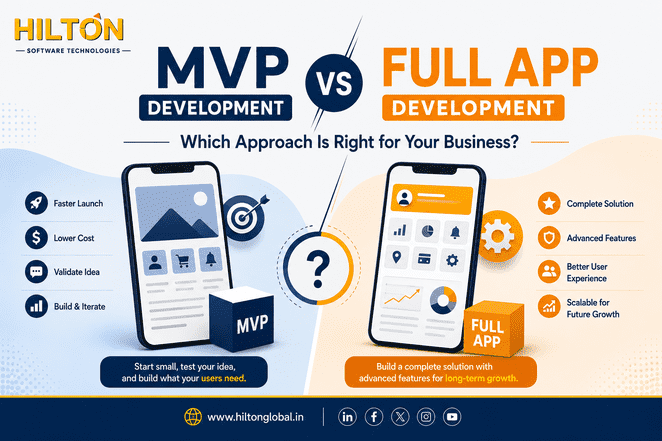
Understanding MVP vs Full App Development can help businesses make better decisions about development costs, timelines, features, user feedback, scalability, and long-term product strategy.
An MVP focuses on launching a product with the essential features required to solve a specific user problem and validate the business idea. Full app development, on the other hand, involves building a more complete product with a broader feature set, advanced functionality, integrations, security, scalability, and a more comprehensive user experience.
So, which approach is right for your business?
The answer depends on your business goals, budget, target audience, market requirements, product complexity, and growth plans.
What Is MVP App Development?
An MVP, or Minimum Viable Product, is an initial version of an application that includes only the most important features needed to deliver value to users and validate the product concept.
The objective of an MVP is not to build an incomplete or low-quality application. Instead, it is to launch a focused product with a clearly defined purpose, collect real-world feedback, and use that information to determine what should be developed next.
For example, imagine a business wants to launch a food delivery application. A full application might include advanced restaurant discovery, loyalty programmes, AI recommendations, multiple payment options, delivery optimisation, promotional campaigns, and extensive analytics.
An MVP could initially focus on:
- User registration and login
- Restaurant listing
- Food selection
- Cart and checkout
- Online payment
- Order tracking
- Basic notifications
Once users start interacting with the application, the business can analyse their behaviour and feedback before investing in additional functionality.
What Is Full App Development?
Full app development involves building a comprehensive application designed to support the broader business requirements from the beginning.
Instead of focusing only on the core functionality, development teams plan the application’s architecture, user experience, integrations, security, scalability, performance, and future requirements.
A full application may include:
- Advanced user management
- Multiple user roles
- Payment gateway integrations
- Third-party API integrations
- Real-time notifications
- Analytics and reporting
- AI-powered features
- Personalisation
- Advanced search and filtering
- Subscription management
- Admin dashboards
- Cloud infrastructure
- Advanced security features
- Automated workflows
- Performance optimisation
This approach can be suitable when the product requirements are already well understood and the business has a clear understanding of its target users and market.
MVP vs Full App Development: Key Differences
The biggest difference between MVP and full app development is the scope and purpose of the initial product.
The right choice depends on what you are trying to accomplish with the application.
When Should You Choose MVP Development?
MVP development can be a strong option when your product idea is new and you want to validate it before making a larger investment.
01. You Have a New Business Idea
If you have an innovative application concept but are unsure how customers will respond, an MVP allows you to test the idea with real users.
Instead of spending heavily on every planned feature, you can focus on the core problem your application is designed to solve.
02. You Want to Reduce Initial Development Costs
Developing fewer features generally means a smaller initial development scope.
This can make MVP development attractive for startups and businesses working with limited budgets.
However, cost should not be the only consideration. A well-planned MVP should have a scalable technical foundation so that future features can be added without rebuilding the entire application.
03. You Need to Launch Quickly
Businesses operating in competitive markets may need to get their product in front of users quickly.
An MVP can help shorten the initial development cycle by prioritising essential functionality instead of developing every planned feature at once.
04. You Need Real User Feedback
Business assumptions do not always match actual customer behaviour.
An MVP provides an opportunity to understand:
- Which features users actually need
- How users interact with the application
- Where users experience problems
- Which features should be prioritised
- Whether customers are willing to use or pay for the product
This information can guide future development decisions.
05. Your Product Requirements Are Still Evolving
If you are still determining the best product features, starting with an MVP can provide greater flexibility.
Instead of committing to a complete feature roadmap immediately, you can refine the product based on market feedback.
When Should You Choose Full App Development?
Full app development may be more appropriate when the business already has clearly defined requirements and understands what the application needs to accomplish.
01. Your Business Requirements Are Clearly Defined
If you already understand your users, workflows, features, and business model, building the complete application may be more efficient than developing an MVP first.
02. Your Application Requires Complex Functionality
Some applications cannot provide meaningful value without multiple interconnected features.
For example, enterprise applications, healthcare platforms, financial applications, logistics systems, and complex e-commerce platforms may require sophisticated functionality from the beginning.
03. You Already Have an Established Customer Base
Established businesses may already have access to customer data, market research, and feedback.
If the product requirements are supported by existing business knowledge, a full application can make sense.
04. Security and Compliance Are Critical
Applications handling sensitive business or customer information may require security architecture, authentication, authorisation, auditing, data protection, and other technical requirements from the beginning.
In such situations, the development strategy should be based on the application’s specific security and compliance requirements rather than simply minimising the initial feature set.
05. The Application Is Part of a Larger Digital Ecosystem
If the application needs to connect with existing ERP, CRM, payment, analytics, cloud, or business systems, full development may be appropriate when those integrations are essential to the product’s core functionality.
MVP vs Full App Development: Cost Considerations
Cost is one of the most important factors businesses consider when comparing MVP vs Full App Development.
An MVP generally requires a smaller initial development scope because the team concentrates on core functionality.
Full app development requires a larger initial investment because more features, integrations, testing, infrastructure, and design requirements need to be addressed.
However, the cheapest option is not always the best option.
A poorly planned MVP can create technical debt and require significant redevelopment later. Similarly, building a full application without validating market demand can result in unnecessary features and wasted investment.
The better approach is to balance initial investment, product validation, technical quality, and long-term scalability.
MVP vs Full App Development: Time to Market
Time to market can influence which development approach a business chooses.
An MVP can potentially reach users faster because the development team focuses on the product’s essential functionality.
A typical MVP development process may include:
- Business and market analysis
- Feature prioritisation
- UX/UI design
- Technical architecture
- Core application development
- Testing
- MVP launch
- User feedback and analytics
- Feature prioritisation
- Product improvements
Full app development typically requires a broader planning and development cycle because more functionality must be designed, implemented, tested, and optimised before launch.
How to Decide Between MVP and Full App Development
Before choosing an approach, ask these questions:
Do you need to validate your idea?
If yes, an MVP may be the better starting point.
Do you already understand your target users?
If you have extensive market research and established customer feedback, full development may be appropriate.
Is your application technically complex?
If the product depends on multiple integrations, advanced workflows, or complex infrastructure, you may need a more comprehensive development strategy.
Is your budget limited?
An MVP can help distribute investment across multiple development stages.
Do you need to launch quickly?
If speed is a priority, focusing on essential functionality can help bring the product to market sooner.
Is scalability important?
Regardless of whether you choose an MVP or full application, scalability should be considered during architecture and technology planning.
How MVP Development Can Reduce Product Risk
One of the biggest advantages of MVP development is the ability to validate assumptions before making a larger investment.
Instead of asking:
“Can we build this application?”
businesses can focus on:
“Will users actually use this application?”
This distinction is important.
An MVP allows businesses to test product-market fit, collect customer feedback, monitor application usage, and identify the features that provide the greatest value.
The next development phase can then be based on evidence rather than assumptions.
Why the Technology Stack Matters
The choice between MVP and full app development should also consider the technology stack.
Modern businesses can use technologies such as Flutter, React Native, native Android, and native iOS development depending on application requirements.
Cross-platform frameworks can be useful when businesses want to develop applications for multiple platforms while sharing a significant portion of the codebase.
However, technology selection should be based on factors such as:
- Application complexity
- Performance requirements
- Platform requirements
- Development timeline
- Existing infrastructure
- Third-party integrations
- Scalability
- Maintenance requirements
- Long-term product roadmap
A professional development team can evaluate these factors before recommending the right architecture.
The Role of Mobile App Development Services
Choosing the right Mobile App Development Services provider can significantly influence the success of your application, whether you start with an MVP or build a complete product.
A reliable development partner should understand more than just coding. The team should be able to evaluate your business requirements, identify the core product functionality, recommend an appropriate technology stack, design a user-friendly experience, and create an architecture that supports future growth.
Professional Mobile App Development Services can support businesses through:
- Product discovery
- MVP strategy
- UI/UX design
- Cross-platform app development
- Native mobile app development
- API development and integration
- Third-party integrations
- Cloud integration
- Testing and quality assurance
- Application security
- Deployment
- Maintenance and support
- Feature enhancements
The objective should be to create a mobile application that is useful today while remaining flexible enough to evolve tomorrow.
MVP to Full Product: A Practical Development Roadmap
Choosing an MVP does not mean you are committing to a small application forever.
A common product development journey can look like this:
Idea → MVP → User Feedback → Product Validation → Feature Expansion → Full Product → Continuous Optimisation
01. Define the Problem
Identify the customer problem your application needs to solve.
02. Identify Core Features
Separate essential features from features that can be introduced later.
03. Build the MVP
Develop a stable, usable product containing the core functionality.
04. Launch and Measure
Release the application to the target audience and monitor user behaviour.
05. Collect Feedback
Use customer feedback, analytics, reviews, and support requests to identify improvement opportunities.
06. Prioritise New Features
Develop features based on user demand and business value.
07. Scale the Product
Improve infrastructure, performance, security, integrations, and functionality as the user base grows.
This approach allows businesses to evolve their application based on actual market requirements.
Common Mistakes to Avoid When Building an MVP
An MVP should be minimal, but it should not feel unfinished or unreliable.
Avoid these common mistakes:
Building Too Many Features
Adding every planned feature defeats the purpose of an MVP.
Focusing Only on Development Cost
Reducing cost by compromising architecture, security, testing, or usability can create bigger problems later.
Ignoring User Experience
A simple application still needs an intuitive and professional user experience.
Building Without a Future Roadmap
The MVP architecture should consider how the application may evolve after validation.
Ignoring Analytics
Without measuring user behaviour, it becomes difficult to understand whether the MVP is achieving its purpose.
Treating MVP as the Final Product
An MVP is generally a starting point for learning and product evolution, not necessarily the finished application.
MVP vs Full App Development: Which Is Better?
There is no universal answer.
Choose MVP development when:
- You are testing a new business idea
- Market demand is uncertain
- You want to validate product-market fit
- You need to launch quickly
- Your initial budget is limited
- Your requirements may change based on user feedback
Choose full app development when:
- Your product requirements are clearly defined
- You already understand your target audience
- The application requires complex functionality
- Multiple integrations are essential
- Security or compliance requirements demand a comprehensive architecture
- You have an established market and sufficient development resources
For many businesses, the most practical approach is not strictly MVP or full development. It is a phased development strategy that starts with the most important functionality and progressively expands the application based on business priorities and user feedback.
Final Thoughts
The decision between MVP vs Full App Development should be based on your business objectives rather than simply development cost or speed.
An MVP can help businesses validate an idea, reach users faster, reduce initial investment, and make product decisions based on real-world feedback. Full app development can be more suitable when requirements are clearly established, the application is complex, or comprehensive functionality is required from launch.
Whichever approach you choose, the foundation matters. A well-designed architecture, intuitive UX, secure development practices, scalable technology, and a clear product roadmap can help your application grow with your business.
If you are planning a new mobile application and are unsure whether to start with an MVP or build a complete product, professional Mobile App Development Services can help you evaluate your requirements and select the right development strategy.
Frequently Asked Questions
What is the difference between MVP and full app development?
+
Is an MVP cheaper than a full application?
+
How long does it take to build an MVP?
+
Can an MVP become a full application?
+
Should startups build an MVP first?
+
What should be included in an MVP?
+
Which technology is best for MVP app development?
+
How do I choose the right mobile app development company?
+
Conclusion
Choosing between MVP and full app development is ultimately a strategic business decision.
If you need to test an idea and learn from your users, an MVP can provide a focused path to market validation. If your requirements are already established and your application demands extensive functionality, full app development may be the better choice.
The key is to build the right product for your current business stage while keeping future growth in mind.