

If you’ve started looking for a development partner, you’ve probably noticed the same problem everywhere: most agencies are good at one thing. Some are strong on the web side — clean websites, solid backends, decent hosting setups. Others live and breathe mobile — smooth iOS and Android builds, App Store submissions, push notifications. Very few do both well under one roof.
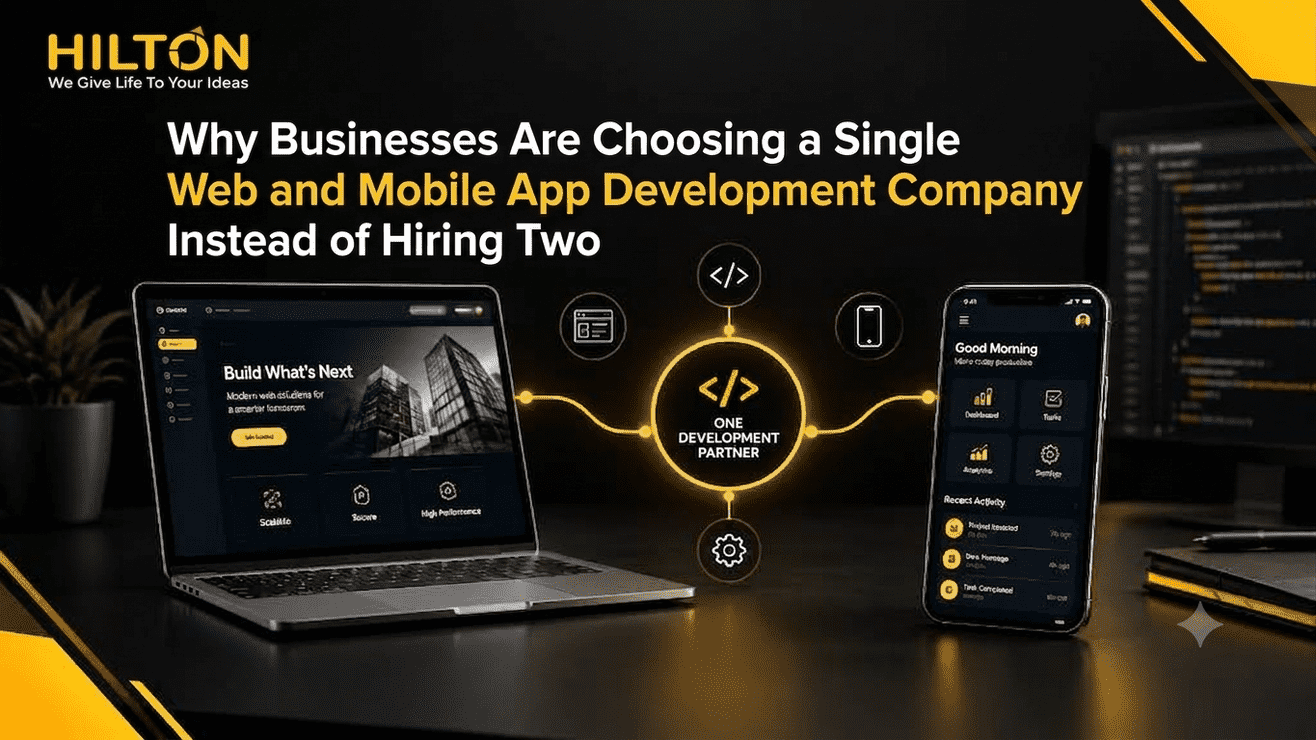
That gap is exactly why more founders and product teams are now searching for a single web and mobile app development company rather than splitting the work between two vendors. It sounds like a small decision on paper. In practice, it changes how fast you ship, how consistent your product feels, and how much time you spend managing handoffs instead of building.
At Hilton Software Technologies, we were built to solve this exact problem. We’re a Hyderabad-based development company that delivers both Web App Development Services and Mobile App Development Services from the same engineering team, working off the same codebase, design system, and product roadmap.
The Real Cost of Splitting Web and Mobile Across Two Vendors
Before comparing services, it helps to understand why “one team, two platforms” has become the preferred model for serious product companies.
When your website is built by one agency and your app by another, a few things tend to happen:
- APIs get built twice, once to suit the web team’s assumptions and again to suit the app team’s — even when they’re serving the same data.
- Design drifts. Your web product looks like one brand, and your app looks like a slightly different one, because two design teams interpreted the same brief differently.
- Bugs get blamed on “the other team.” When something breaks between the app and the backend, you spend days figuring out whose responsibility it is before anyone even starts fixing it.
- Timelines stack instead of overlap. Web launches, then mobile starts from scratch months later, instead of both moving in parallel.
None of this is anyone’s fault — it’s just what happens when two separate vendors, with two separate contracts and two separate priorities, are asked to build one connected product.
A combined web and mobile app development company removes that friction by design. The same backend team that builds your APIs for the website also builds the endpoints your app consumes. The same product manager tracks both roadmaps. When you ask “can this feature launch on web and mobile in the same sprint,” the honest answer is usually yes — because there’s no handoff to manage.
What Full-Service Web App Development Services Should Actually Include
“Web development” gets used loosely. At Hilton Software Technologies, our Web App Development Services cover the full lifecycle, not just writing code against a design file:
Discovery and architecture — Before any code is written, we map out how your product needs to scale: expected traffic, data complexity, integrations with third-party tools, and where the business is likely to be in 18 months, not just at launch.
Frontend engineering — Using modern frameworks like React, Next.js, and Angular, we build fast interfaces, responsive across devices and don’t require a rebuild the moment your product grows.
Backend and API development — Node.js, Python, and Java-based backends built with the same APIs your mobile app will eventually need, so nothing is duplicated later.
Database design — Choosing and structuring the right database (SQL or NoSQL) based on how your data actually behaves, not a default choice made out of habit.
Cloud deployment and DevOps — AWS, Azure, and GCP deployments with CI/CD pipelines set up from day one, so releases aren’t a manual, error-prone process six months in.
Post-launch support — Bug fixes, performance monitoring, and feature iterations after go-live, because a web app’s real work starts after launch, not before.
This is the standard we hold every web engagement to, whether it’s a SaaS dashboard, an eCommerce platform, or an internal enterprise tool.
What Full-Service Mobile App Development Services Should Actually Include
The same completeness applies on the mobile side. Our Mobile App Development Services are built to take a product from idea to App Store and Play Store listing, and then keep it healthy after launch.
Native and cross-platform builds — We build natively in Swift and Kotlin when performance demands it, and use Flutter or React Native when speed-to-market and shared codebases matter more. Which approach fits is a conversation we have with you early, based on your product’s actual requirements, not a one-size-fits-all pitch.
UI/UX designed for mobile behavior, not shrunk-down web — Mobile users tap, swipe, and scroll differently than desktop users click. Our design process treats mobile as its own discipline, not a smaller version of the website.
Backend integration — The mobile app talks to the same backend infrastructure as your web product, so you don’t have to build the same business logic twice.
App Store and Play Store deployment — Handling submission requirements, compliance checks, and store optimization so your app doesn’t get stuck in review limbo.
Push notifications, offline functionality, and device-level features — Camera access, GPS, biometric login, and offline data sync, implemented properly rather than bolted on.
Ongoing maintenance — OS updates from Apple and Google happen constantly. An app that isn’t maintained against these updates degrades fast, even if nothing about your product changed.
Why Hyderabad Businesses Specifically Benefit From a Local Team
Working with a web and mobile app development company based in Hyderabad has practical advantages that outsourcing overseas doesn’t offer.
Time zone alignment means real-time collaboration instead of asynchronous back-and-forth that stretches a two-day fix into a two-week one. In-person meetings are possible when a project genuinely needs them — a whiteboard session solves in an hour what a dozen emails can’t. And Hyderabad’s developer talent pool, shaped by the city’s strong IT and product engineering ecosystem, means access to engineers who understand both enterprise-grade requirements and startup speed.
For businesses in Hyderabad, Telangana, or elsewhere in India building for a global market, this combination of local accessibility and international delivery standards is a genuine differentiator — not just a location on a website footer.
How to Evaluate a Web and Mobile App Development Company Before You Sign
If you’re comparing vendors right now, a few questions tend to separate the agencies that can actually deliver both platforms from the ones that will quietly subcontract one of them out:
- Does one engineering team own both platforms, or is mobile handled by a different internal team (or worse, a freelancer network)?
- Can they show you web and mobile projects built for the same client, where the two products clearly share a design system and backend?
- What’s their post-launch support model? A product that isn’t maintained after launch starts losing value within months.
- How do they handle scaling? Ask what happens to your architecture if user numbers 10x within a year — the answer tells you whether they built for today or for growth.
- Do they explain trade-offs, or just agree with everything you propose? A development partner worth keeping will tell you when native beats cross-platform, or when a feature isn’t worth the engineering cost yet.
Building Web and Mobile as One Product, Not Two Projects
The strongest products today aren’t “a website” and “an app” that happen to share a logo. They’re one product experienced across two surfaces — with the same data, the same design language, and the same roadmap driving both forward.
That’s the approach Hilton Software Technologies takes with every engagement. Our Web App Development Services and Mobile App Development Services aren’t run as separate business lines with separate teams — they’re delivered by developers who work across both, so what you launch on the web and what you launch on mobile were always meant to be the same product.
If you’re planning a build that needs to live on both platforms, it’s worth starting that conversation with a team that won’t need to hand your project off to someone else halfway through.
Frequently Asked Questions
What is the difference between a web app and a mobile app development company? A web development company builds browser-based applications and websites, while a mobile app development company builds native or cross-platform apps for iOS and Android. A combined web and mobile app development company like Hilton Software Technologies builds both, using shared backend infrastructure so the two platforms stay consistent.
How long does it take to build a web and mobile app together? Timelines vary by complexity, but building both platforms in parallel with one team is typically faster than building them sequentially with two separate vendors, since the backend and API work is done once and used by both.
Should I choose native or cross-platform mobile development? It depends on your app’s performance needs, budget, and timeline. Native development (Swift/Kotlin) offers the best performance for complex, device-intensive apps. Cross-platform frameworks like Flutter or React Native are often the better choice when speed-to-market and a shared codebase matter more.
Does Hilton Software Technologies provide support after the app is launched? Yes. Post-launch support, including bug fixes, performance monitoring, OS-update compatibility, and feature iterations, is part of our Web App Development Services and Mobile App Development Services engagements.
Is Hilton Software Technologies based in Hyderabad? Yes, Hilton Software Technologies (Hilton Software Technologies Pvt. Ltd.) is based in Hyderabad, working with businesses locally and globally on web, mobile, AI/ML, and eCommerce development.